
If you’re starting a business in Singapore, you’ve probably come across the terms bookkeeping and accounting. While many people use them interchangeably, they serve different purposes and are both essential for maintaining a financially healthy business.
Understanding the difference between bookkeeping and accounting services helps business owners choose the right support, stay compliant with Singapore regulations, and make better financial decisions.
In this guide, we’ll explain how bookkeeping differs from accounting, what each service includes, when your business needs both, and how outsourcing these services can save time and money.
What’s the Difference Between Bookkeeping and Accounting Services?
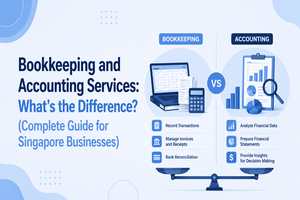
Bookkeeping and accounting services work together but serve different purposes. Bookkeeping focuses on recording and organising daily financial transactions, while accounting interprets that financial data to prepare reports, manage tax compliance, support business decisions, and ensure compliance with ACRA and IRAS regulations.
In simple terms:
Bookkeeping records the numbers.
Accounting explains what those numbers mean.
Most businesses require both services to maintain accurate financial records and achieve long-term growth.
Why Bookkeeping and Accounting Matter for Singapore Businesses
Every registered company in Singapore must maintain proper accounting records and meet statutory obligations.
Whether you’re a startup, SME, or established company, good financial management helps you:
Stay compliant with ACRA and IRAS requirements
Monitor cash flow
Prepare financial statements
File taxes accurately
Make informed business decisions
Build investor and lender confidence
Without accurate bookkeeping, accountants cannot prepare reliable financial reports or provide meaningful financial advice.
What Is Bookkeeping?
Bookkeeping is the process of recording every financial transaction that occurs within your business.
It provides the financial data that accountants later analyse.
Typical bookkeeping tasks include:
Recording income and expenses
Bank reconciliation
Managing accounts payable
Managing accounts receivable
Recording invoices
Tracking supplier payments
Maintaining general ledgers
Bookkeeping ensures financial information remains organised and up to date.
What Is Accounting?
Accounting goes beyond recording financial transactions.
Professional accountants analyse bookkeeping records to prepare financial reports, ensure regulatory compliance, and provide strategic financial guidance.
Accounting services typically include:
Corporate tax filing
Budgeting
Cash flow analysis
Financial forecasting
Tax planning
Business advisory
Accounting transforms financial data into insights that help business owners make informed decisions.
Bookkeeping vs Accounting: Side-by-Side Comparison
Bookkeeping | Accounting |
Records financial transactions | Analyses financial information |
Daily or weekly activity | Monthly, quarterly, or annual reporting |
Maintains financial records | Interprets financial performance |
Organises invoices and receipts | Prepares financial statements |
Reconciles bank accounts | Handles tax planning and compliance |
Focuses on accuracy | Focuses on business insights |
Bookkeeping creates accurate financial records, while accounting uses those records to support business planning and regulatory compliance.
What Does a Bookkeeper Do?
A professional bookkeeper is responsible for maintaining organised financial records.
Daily responsibilities often include:
Recording business transactions
Reconciling bank accounts
Managing invoices
Tracking expenses
Monitoring accounts receivable
Processing supplier payments
Organising supporting documentation
Their work ensures accountants receive complete and accurate financial information.
What Does an Accountant Do?
Accountants use bookkeeping data to provide a broader financial perspective.
Their responsibilities often include:
Preparing financial statements
Preparing GST returns
Analysing financial performance
Advising on business growth
Budget planning
Cash flow forecasting
Supporting audits
Regulatory compliance
Professional accountants also help businesses identify financial risks and opportunities.
Do Small Businesses Need Both?
Yes.
Many small business owners believe bookkeeping alone is enough.
However, bookkeeping without accounting only provides financial records—it doesn’t explain what those records mean or help businesses meet statutory obligations.
Similarly, accounting cannot be performed accurately without proper bookkeeping.
Together, bookkeeping and accounting services provide:
Accurate financial records
Better decision-making
Tax compliance
Reliable financial reporting
Improved cash flow management
Businesses that invest in both services are generally better positioned for long-term growth.
Benefits of Outsourcing Bookkeeping and Accounting Services
Many SMEs choose to outsource both functions instead of hiring an internal finance team.
Benefits include:
Lower Operating Costs
Outsourcing eliminates:
Recruitment expenses
Employee salaries
CPF contributions
Software licences
Ongoing staff training
Better Compliance
Professional accounting firms stay updated with changing Singapore regulations, reducing the risk of filing errors and penalties.
Improved Accuracy
Experienced professionals use established processes and cloud accounting systems to maintain accurate financial records.
Access to Financial Expertise
Instead of relying on one employee, outsourcing gives businesses access to specialists in bookkeeping, tax, payroll, GST, and financial reporting.
More Time to Focus on Growth
Business owners can spend less time managing paperwork and more time growing their business.
When Should You Upgrade from Bookkeeping to Full Accounting Services?
Many startups begin with bookkeeping only.
As businesses grow, additional accounting support becomes increasingly valuable.
You should consider full accounting services if you:
Register for GST
Hire employees
Require monthly financial reports
Apply for business loans
Seek investment
Expand operations
Experience increasing transaction volumes
Accounting evolves alongside your business.
How Cloud Accounting Brings Both Services Together
Modern cloud accounting software allows bookkeepers and accountants to work from the same financial information in real time.
Benefits include:
Faster reporting
Automatic bank feeds
Secure document storage
Improved collaboration
Real-time financial visibility
Cloud accounting also reduces manual data entry and improves accuracy.
Why Businesses Choose Accounting Consultancy
At Accounting Consultancy Pte Ltd, we provide both bookkeeping and accounting services under one roof, helping startups and SMEs simplify financial management while remaining compliant with Singapore regulations.
Our comprehensive services include:
Bookkeeping
Accounting
Payroll Processing
GST Filing
Corporate Tax Services
Financial Statement Preparation
Audit Support
Cloud Accounting Solutions
Whether you’re launching a new business or managing an established company, we tailor our services to match your business needs as you grow.
Why Trust Accounting Consultancy?
Since 2009, Accounting Consultancy Pte Ltd has helped businesses across Singapore manage their finances with confidence.
Our experienced team supports startups and SMEs with reliable bookkeeping, accounting, payroll, taxation, GST compliance, company secretarial services, and financial reporting.
By combining technical expertise with personalised support, we help business owners stay compliant, improve financial visibility, and make informed decisions for sustainable business growth.
Ready to Simplify Your Business Finances?
Understanding the difference between bookkeeping and accounting services is the first step toward building a financially healthy business.
Whether you need accurate bookkeeping, strategic accounting support, payroll management, tax compliance, or a complete financial solution, Accounting Consultancy Pte Ltd is here to help.
Contact us today to discuss your business requirements and discover how our integrated bookkeeping and accounting services can support your long-term success.
Frequently Asked Questions
What is the difference between bookkeeping and accounting?
Bookkeeping focuses on recording daily financial transactions, while accounting analyses that information to prepare reports, manage tax compliance, and support business decisions.
Can a business operate with bookkeeping only?
Small businesses may begin with bookkeeping alone, but most eventually require accounting services for tax filing, financial reporting, and compliance.
Is bookkeeping part of accounting?
Yes. Bookkeeping is the foundation of accounting. Without accurate bookkeeping, accountants cannot prepare reliable financial statements or tax returns.
Should startups outsource bookkeeping and accounting?
Many startups outsource both services because it provides professional financial support without the expense of hiring an in-house finance team.
How often should bookkeeping be updated?
Bookkeeping should ideally be updated monthly—or more frequently for businesses with higher transaction volumes—to maintain accurate financial records and timely reporting